Thursday, April 02, 2015

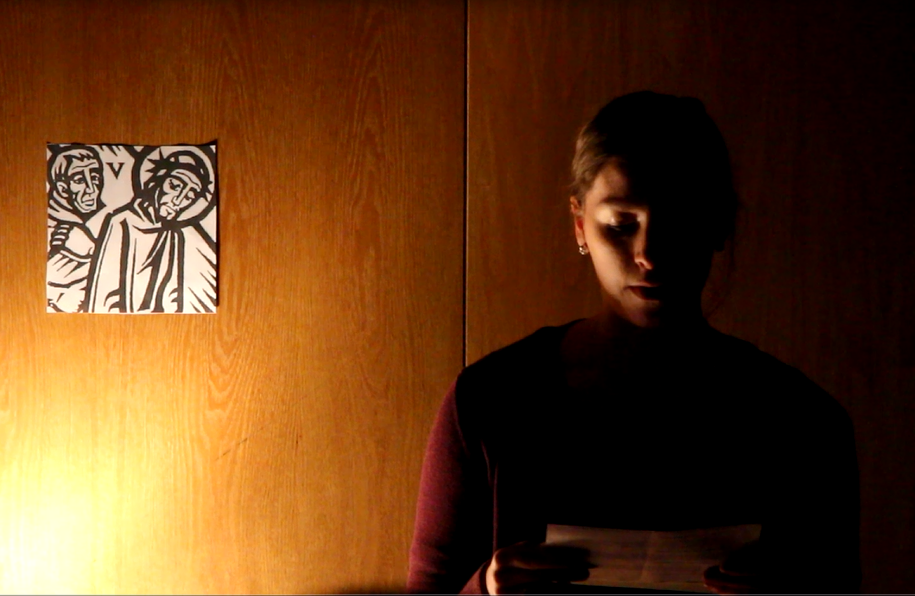
The Twelfth Station: Jesus Dies on the Cross

The following is a Lenten reflection written by Danny Tortelli, one of this year's South House Volunteers.
Maybe a week before Thanksgiving break during my first year of Amate, I found myself standing in the cafeteria of Perspectives as a lunchroom chaperone. I wasn't in there long before an 8th grade scholar of mine, Kenny, came up to me.

“Mr. Tortelli, you get my Turkey-gram?” With my mind in a million other places, it sadly took me a moment to figure out what he was talking about.  It was an assignment that was given to the middle school students in their Disciplined Life (or “character-building”) classes. Here, each student would write a turkey themed telegram to a staff member about how grateful they are for said individual. At the time I highly doubted I, as a first year volunteer teachers-assistant with a last name only 2 letters away from “tortilla”, would be receiving one of these kind and cute affirmations when it seemed only the well-seasoned, easier to pronounce staff members were getting them.

“No, I haven't,” I told him. “I don't have a desk for deliveries.” He laughed and shook my hand. “Oh, they're probably gonna deliver it right to you. I wrote one for you to say thanks for helping me on my math test.” At this point I didn't really care where it was, or if I ever got the chance to see it. The thought in itself was warming, but to get to the heart of why this Turkey-gram meant so much, you need the whole story:

This same student had his fair share of setbacks. Behaviorally and academically, he struggled. Very cordial and kind when talking one-on-one, he would often zone out, talk to other students, or “explore” the fine inner-workings of writing utensils instead of paying attention to lessons when working alone.

At the end of my first day of interventions with him, it didn't look like we'd be going far that year. I spent as much time that first day getting him to stop cracking jokes and pens as I did rehashing algebra. Nearly every day after, we tried and tried again; working one-on-one after the teacher had given her directions, trying our hardest just to reinforce new material.

I had tried being more lighthearted with him in our one-on-ones, and even took him to other classrooms to get away from possible distractions. He responded better when the pressure of his classmates wasn’t as high, and I think he even grew to enjoy class a bit more. It became a point of familiarity for Kenny, or a checkpoint throughout his day, and mine. When we’d see each other in an earlier class he would always make sure to ask, "You gonna pull me out of math today?"

During those first few weeks, there were definitely moments of hope; good marks on class work, getting problems correct on homework, more participation in class and so on. He even began beating me to the punch with a lot of the practice problems and getting them done without my help. However, the progress often stalled and seemed marginal. There were just as many instances where he would be marked for things like “incorrect”, “incomplete”, “needs to show work”. Even after the third week of learning “how to find the missing side length of triangles”, it was a stretch to get him to identify which side is the hypotenuse. For those like me who shamefully can't remember on their own, a hypotenuse is the side opposite of the right angle.

As our triangle unit was ending, there was a looming two-part test that drew nearer and nearer. I was getting anxious: from my own bad math experiences to the realization that this student wasn't doing well in class, I couldn't help but be a little fearful. The day before the test, while working alone on a review sheet, he could barely answer the first two hypotenuse questions on his own, and even when he did they were incorrect.

I left our class thinking I'd failed him. This happens often to me at school. One day I leave believing I really made a break-through with a scholar, getting them to pick up their character and stay on point with grades, and the next they give up the effort, pick fights, talk back, and lose respect for everyone in the room, including themselves. Kenny could certainly be that kid at times. I assumed the next time we'd see each other it'd be with a fat “F” and a heavy chandelier holding over both our heads for the rest of the year.

It wasn't until he pulled me aside at the end of the next day to tell me how wrong I was:

“Mr. Tortelli, Ms. Reigelmeyer graded my test in class and said I got an A.”

He’s lying, I thought. “Say what?”

“Yeah, she graded it and said I better do just as good tomorrow on the next part.”

No way he passed… let alone aced it?! He cheated! He must have wrote the answers on his hands... something!

He reached to shake my hand. Clean as a whistle.

Meanwhile his teacher, hearing our conversation from her room, stepped out to congratulate the two of us and, more importantly, verify that “He’s telling the truth!”

I can’t talk about the death of Jesus as if I’ve ever witnessed or been part of something so tragic, but I can talk about the loss of hope. The ever pounding questions that rush through my head daily: “Am I getting through to this student?” “Am I a good enough role model?” “Am I the right role model?” “Will I, or even this school, ever be enough for these kids?” In a sense, there is that death: Inspiration, courage, the aforementioned hope. They can all disappear at the first sight of failure. It doesn’t take much for us to fall, but there are moments around you when you realize you’re doing alright.

In seeing Jesus on the cross, he carries his mission to its completion – despite the hardships, failures, and fear he must have faced, he is faithful to the very end. For me, the Turkey-gram itself was great, but more than anything it was a reminder that our work does go to some purpose. Kenny got an “A.” He thanked me, and I am so very grateful. Now a freshman in the High School of Technology one floor above us, four inches taller and about 30 pounds heavier, he continues to thank me at least once a week when he runs up to me on the way to my car after school, smiling ear to ear, and tackling me to the ground with a bear hug, shouting “Mr. Tortilla!”.

The story goes that Jesus died so that others may have a better tomorrow. While we should strive to never give up our hope, it’s reassuring, as I learned, that even if it does die for a day, it can still dawn a better tomorrow.

This reflection based off of an original story of mine, “gratitude in the grind”. You can read that post in it’s original entirety and more on my blog: Danbook

Wednesday, April 01, 2015

The Tenth Station: Jesus is Stripped of His Garments

The following is a Lenten reflection written by Anna Paige Frein, one of this year's South House Volunteers.

Here we see Jesus being stripped of his clothes symbolizing a stripping of not only his divinity but his human dignity. This is a final moment of humiliation for Christ on his journey to the cross. As the crowds gathered to mock him, He was left exposed and ashamed. Despite this humiliation, Christ continued in silence trusting the path of salvation before Him.

Throughout this past year at St. Sabina Emergency Assistance Department I have encountered clients who are on their own journey of suffering like Christ who have been stripped by the difficulties of the world and have come to a point of feeling exposed and ashamed. Some have been stripped of their income and feel ashamed because they have to use a food pantry to feed their families. Others have been stripped of their possessions and feel shame because they do not have a nice shirt to wear to a job interview. Still others have been stripped of steady employment and feel exposed because they have not been able to pay their rent and are facing eviction.

A few weeks ago a woman came to our food pantry looking for assistance. She had left a domestic violence situation the day before and all she had were the clothes on her back and a few dollars in her wallet. She had been stripped of her home, her relationship, and her self-respect and she did not know who to turn to because she felt too ashamed to ask her family members for help.


Many clients at St. Sabina admit to me that they are reluctant to ask for help because of the sense of shame associated with it, but the real shame today is that we often forget that we are all brothers and sisters in Christ. We forget how to love others for who they are because we are more concerned with what they have. At the end of the day if you take away money, clothes, possessions, or status then all we have left is our being. It is then that we discover that we are all equal and created in the image of God.

Admittedly, I have not personally felt the shame associated with being stripped of money, possessions, or status like my clients. I grew up in a stable home with parents who could always provide for me. So when I reflect on this station during Lent, I think about the things that I personally need to be stripped of in order to love unconditionally. These things include my pride, self-centeredness, and social prejudices. This helps remind me of our equality and our responsibility to love each other just as Christ taught us.

Tuesday, March 31, 2015

The Ninth Station: Jesus Falls the Third Time

The following is a Lenten reflection written by Adam Kretz, one of this year's South House Volunteers.

“The last fall is devastating; Jesus can barely proceed to the end. Summoning all his remaining strength, supported by his inner trust in God, Jesus collapses under the weight of the cross. His executioners look at him as a broken man, pathetic yet paying a price he deserves. They help him up so he can make it up the hill of crucifixion.”

I procrastinated as I always have in the past with writing assignments; the trouble is always in getting started. Intending to transmit an important and meaningful message while preparing myself to share something intimate in order to write that document. The How I've found is always the difficult part. It is the doing, the sacrificing of time. The decision to dedicate energy and attention to something on faith that is for a higher purpose, on faith that it is serving a greater good, it is a difficult and draining commitment. Finding a way to do all this in the span of an hour seems like futile effort. But that’s the thing about procrastination; it is not the act of putting things off as much as it is a way of rationalizing why not do something important, meaningful, vulnerable.

When I sat down to reflect on this ninth station I found myself feeling embarrassed and slightly ashamed of how little I actually know about this Man, this one true Son of God that I have lately been hearing so much about. Now I was baptized and raised as a Catholic, educated on the faith by my parents and by my religious education classes. After all these years I have only held on to a general idea of who Jesus was and why he died on the cross. I am no longer a Catholic and so I am less ashamed to admit to having watched a 2 and half minute video titled: Who is Jesus put out by the channel Bibles for America, which helped only confirm what I already knew about the story: that Jesus is God and the only son of God and that he lived an amazing life and helped many people before having to sacrifice himself in order to save all of us from going to hell.

At that pointed I stopped to think about this sacrifice through my new prism of faith. What would it mean for “God”, in the way that I understand “God” to kill itself? The sacrifice of a child of God who is also God, so that everything is better off, this is a very difficult thing for me to wrap my head around. It made me think of this idea of Opportunity Cost that’s found in Economics, that states when you choose to do one thing you cost yourself the opportunity do another. For a long time in my life I have been consumed by my gambling addiction and the many vices that come along with, the cigarettes, the partying,  the drugs, the tv and alcohol. So many distractions, but most dangerous part was what it took me away from. Which was a meaningful life. My addiction kept me from spending quality time with my family and friends, from working on my goals and dreams, all the things I care about most, instead I was shackled to the wall of the closest casino, stuck inside my prison, my hell. I stayed there for so many years chained up, distracted from the hard, difficult, uncomfortable things that were my footholds toward a better life. But before this year of service began I fought my way through the pain and pressures of my struggle that had always kept me down. I got beyond the next roll of the dice because I realized that I will never become the person I was meant to be if I am trapped behind the walls of temptation and indulgence.

Like many prodigious figures in history I only generally understand. Jesus for me is a beautiful example of this intentional faith based way of living and dying. I wonder to myself, what does it mean to be so committed to one’s relationship with God where you must sacrifice and trust even when it’s painful, even when others may not understand, even when you may not understand yourself?

In Station nine Jesus is at the point where he can physically no longer bear the weight of the cross. His muscles give out and the final moments of his life come to a close. For me this station is about understanding why it is sometimes necessary to deliberately push myself past pleasure and comfort in order to be put through pain, because the mission, the goal, the future I want for myself, my family, my friends, my fellow humans, is on the other side of that hurt, it is only a hurdle in the way, how you overcome it is in that trust and support from The Divine, The Infinite.

Friday, March 27, 2015

The Sixth Station: Veronica Wipes the Face of Jesus

The following is a Lenten reflection written by Paul Marsh, one of this year's South House Volunteers.

I majored in Economics in undergrad. The thing that really gets me going about Economics is that it offers mathematical proof of correct human behavior. One of the basic principles of free trade economics is the idea of comparative advantage, which basically states that no matter how many things you’re good at, you should focus on the thing you’re the best at, and then do that thing for other people. Let’s say we live in opposite land, where I’m great at both cooking and cleaning, and all of my South House roommates are terrible at them both. You’d think that if I were acting in my own best interest, I would just cook and clean for myself, while letting my roommates wallow in their own pathetic attempts to microwave toast. But actually, I’m better off if I do all of their cooking for them, and let them clean. In other words, the idea of “I don’t need your help” holds very little weight. Math backs this up. Math seriously says we should be nice to each other. We see this economic principle of comparative advantage at play in the sixth station, when Veronica wipes the sweat and blood off of Jesus’ face. Jesus could probably do this more efficiently than Veronica, because he is literally God. However, while Veronica is busy wiping, Jesus is able to spend that time performing a small yet beautiful miracle.


This idea of help being a two-way street is expressed most succinctly in the Prayer of St. Francis, with the line, “for it is in giving that we receive.” But we find it elsewhere in the Catholic faith, and often enough that it could be described as a tenet of Catholicism. I've experienced this tenet a lot this year in my work at Taller de Jose. As I've given my time to work with countless clients, many of them have given me things in return. My client Juan gave me a “Buy One, Get One” free card for Cheesie’s, which I was super pumped about until I noticed it had expired 2 years ago. Fernando gave me a very difficult Spanish test every time he mumbled on the phone. Luisa gave me a smelly hug. Jessica gave me a bottle of women's lotion. Mario gave me his life, when he promised he wouldn't kill himself. Linda gave me tacos from El Milagro, which, speaking of small yet beautiful miracles. If someone asked me to present them with everything I'd received at work this year, I wouldn't have much to show, since I ate the tacos in about 2 seconds. But the real gift that I have received this year is a better understanding of what it means to help. Helping is not just an action, it's a state of being. It's a community that we choose to enter in to once we learn, whether it's from our faith, from economics, from wherever, just how much we stand to gain by doing so.

Thursday, March 26, 2015

The Fifth Station: Simon Helps Jesus Carry the Cross

The following is a Lenten reflection written by Caitlin Kerwin, one of this year's South House Volunteers.

As I walked home from work, I noticed a man sitting on the curb. I honestly don’t know if I would have paid him any attention if he didn’t shout “I’m hungry, ma’am!” Having lived in Chicago for a few months at this point I wasn't surprised by this man, but he did startle me a bit. I responded to him quickly saying “Sorry, Lakeview Pantry is right down the road.” This did not seem to satisfy him as he said “I’m from Birmingham, Alabama and I don’t have I.D.” Now, this really would not have prevented him from receiving food, but at the time I was not very informed. I still did not know how to help, so I responded with a “Sorry” and kept walking down the street. God has a funny way of pulling at our heart strings, so as I stopped at the corner to wait for the ‘walk’ sign I could not help but feel a sense of urgency to think of something that might help this man. I felt somehow connected to him as if it were my responsibility to do something about his hunger. I’m not one to give money to people on the street, but I am one that values food. As many of you may know, I like to eat. I looked back at the man sitting on the curb in front of Subway and started walking toward him reluctantly. I asked him if he wanted a sandwich from Subway and he responded “Yes… and can I have a coke too?” I thought why not, I would want one too. The man was very appreciative of the meal and I was on my way.

I saw this man almost every day for the rest of my first year of Amate. At first I didn't know whether to say hi to him or just try to avoid eye contact for fear of him asking for more help. Eventually I got over my pride a little and started smiling at him every day that I walked past. We were connected in some way.


It’s hard to remember my oneness with others and the world when I live in my own bubble. I thought Amate would magically break this bubble and I would have a brand new way of thinking. While Amate has definitely made me more aware of this bubble, it is still a daily struggle to change my way of thinking and break the bubble I have a tendency to live in. We have a responsibility to one another, from the begging man sitting on the road to the housemate sitting on the couch. It is our job as people to help each other carry the many crosses we have in our lives and to realize we are also carrying the same cross.

Tuesday, March 24, 2015

The Third Station: Jesus Falls the First Time

The following is a Lenten reflection written by Skylar Joseph, one of this year's South House Volunteers.

“The weight is unbearable. Jesus falls under it. How could he enter our lives completely without surrendering to the crushing weight of the life of so many on this earth! He lies on the ground and knows the experience of weakness beneath unfair burdens. He feels the powerlessness of wondering if he will ever be able to continue. He is pulled up and made to continue.”

When I heard this passage for the first time, I felt an immediate connection to it. I know that I could relate to the feeling of falling, and not knowing how I would be able to gather the strength to go on. And while my struggles have obviously been different than that of Jesus on his journey to face his crucifixion, I have still faced moments of powerlessness and struggle, as I’m sure we all have.

When I think of this passage, two moments in my life specifically stand out to me, of where I have been in a situation of falling beneath the weight of whatever burden I am carrying.

The first moment is from my senior year of college. During my senior year I had overburdened myself with too many challenging courses, extracurricular activities, leadership positions, and multiple part time jobs. Because of all of these responsibilities I had taken on, I often found myself extremely overwhelmed, and frequently reached the point to where I felt that I could no longer continue to carry everything that I was burdened with. However, regardless of how discouraged I got, I always kept going.

When I would feel overwhelmed by my course load, overburdened by homework, and would feel my grades slipping, all I wanted to do was to give up, not go to class, not do my work, but whenever this would happen, one of my professors would reach out to me, and encourage me to keep trying my best, to keep working hard; they would remind me that I am intelligent, and can overcome the difficulties, and they would always offer me help, and this sign of caring would motivate me to keep going. They believed in me, even when I didn't.

My second example comes from this year. I know that it was probably foolish to think that this year would be a lot easier than it has been, but after how crazy my senior year was, a year of service where I would only be working one job, would have no classes, and would only have community events a couple nights a week, seemed, on paper, like it would be a breeze. However, this experience has been much more difficult than I anticipated, especially in the past couple months.

The site I am serving at has been going through some transitions; specifically, those who have been transitioning in and out, have been my direct supervisors. As a result, I, as well as other year of service volunteers at my site, have been burdened with many more responsibilities than we had at the beginning of the year. These responsibilities have also come with a lot less help and support, due to the fact that our new supervisors must go through the proper trainings and transitions before they become familiar enough with the work to be able to actually help us. Because of this situation of becoming overburdened once again, many days I feel again like I am falling beneath the weight of all of the burdens I try to carry. And unfortunately, this feeling does not just stay with me at work, it follows me home, affecting all other aspects of my life.

But I continue on. I still get up and go to work in the morning, I still work hard at my job, even when I feel like I want to quit. And if someone was to ask me, “Why?”, I would tell them this: “I care about the girls that I work with every day. I have gotten to know them, and now I have a vested interest in their lives. I care about how they do in school, I care about the goals that they share with me, and even though I only see each group of girls I coach for only 90 minutes once a week, I am still hopeful that I am able to make that 90 minutes special for each of my girls. I am motivated to keep going, because I want to continue to make an impact in the lives of these girls. I want to be like the teachers who helped me to succeed in school, by being a similar presence for the girls. I want to encourage them to reach toward their goals, to help them keep their hopes and dreams alive, because it is all too easy to become discouraged, to think our dreams are unattainable, and I don’t want that to happen to the girls I work with, and so this motivates me to keep working hard at my job, so that I am able to continue to make an impact on the lives of the girls I coach.”

We all experience moments in our lives where we feel like we cannot continue to move forward, and yet many of us do. We continue because something or someone is usually there to motivate us, to pull us up and keep us going, just as Jesus was pulled up and made to continue at this point in his journey. Sometimes it is us who need to be pulled up in order to continue, and sometimes we need to be there to pull others up so that they are able to continue to move forward in their lives. We all must overcome hurdles, both great and small, in order to get where we are supposed to go. And each time we are able to push through and carry on when we don’t know how, we are moving ourselves one step closer to accomplishing what we are meant to do in our lives.

Wednesday, March 11, 2015

Conversation with Fr. Michael Pfleger

Hi everyone,

At this past week's Community Night, we were honored to be joined by Fr. Michael Pfleger, the Senior Pastor of St. Sabina Parish. Fr. Pfleger shared some incredible stories about his upbringing on the south side of Chicago, how he got involved with the civil rights movement, and how that helped fuel his passion for faith and social justice. Our two most recent podcast installments include recordings of our evening with Fr. Pfleger:


Tuesday, February 17, 2015

Podcast Update!

Hello friends,

A new installment of The Amate House Experience podcast is now available! In this two-part podcast, Volunteer Adam Kretz sits down with Program Coordinator Becca Muder about her path to Amate House, Pope Francis, simple living, solidarity, technology, community life, and more!

Part one:


Part two:


Also, check out other installments of The Amate House Experience on our website!

Tuesday, January 20, 2015

Discerning a Year with Amate

The following post is written by Catherine Scallen, Program and Recruitment Coordinator with Amate House.

One of the most challenging aspects of recruiting is the simple fact that it is extremely difficult to capture the rambling and complex expanse of a service year in a thirty second elevator pitch. In fact, dare I say, it’s downright impossible. How do you even begin to scratch the surface of what a year with Amate House means? How do you communicate the mechanics of the stipend, the benefits, the transit, the site placements—while simultaneously trying to express that the sum of the year is far greater than its logistical parts?

How do you convey that it is a year for professional and personal development far beyond anything that a standard 9-5 can offer? That you, as a fresh college graduate, are, quite frankly, handed more responsibility than you should be—and that this baptism by fire is, albeit terrifying, a surefire way to discover your immense capacity for creativity that you previously may not have known existed.

How do you explain that the three houses are not just strange converted convent dorm-like living, but rather individual and unique homes in the truest sense of the word? Places where you are pushed and pulled beyond your comfort zone—through bouts of tear-soaked laughter over games of Settlers of Catan, huddling around the one functioning Ethernet cord, hiding a creepy stuffed animal in kitchen cupboards. Places where you cry at the creaky old dinner table in frustration, in confusion at the deep-seated social injustices that now have a face and a name in your students, your clients at work. Homes where you are surrounded by nine, ten, twelve other brilliant and unique beings, each having varying levels of existential crises on the daily—each wanting to share in this clarification of self with one another.

Because that is—in my experience—what these service years are all about: a clarification of self. You will surprise yourself, both in good ways and in bad, you will succeed and you will fail, but you will never do any of these things alone. It is a cycle of nourishment and replenishment—you are filled up through your community, your faith and spirituality, your work, precisely so that you can consistently give yourself back to that same community, faith and spirituality, work. It is a constant cycle, this clarification of self, and though challenging—one that is well worth the undertaking.


Wednesday, January 14, 2015

Discerning Post-Grad Service

The following is a reflection written by Lydia Hawkins, one of this year's Little Village House Volunteers. To learn more about how to apply to be an Amate House Volunteer, click here.

“So, what are you going to do next year?”

The loaded question that plagues senior year of college.

Just when you finally feel like you have settled down from the standard high school question of “Where are you going to college?” and then the over-asked college questions of  “Where are you from? What do you study?,” this question pops up and reminds you not too get too comfortable.

Some seniors seem to have it all figured out. They’re graduating with the major they first declared, their resume is filled with activities and honors that pave a smooth path to their goal, and they've got the year after college all figured out simply because it’s what they've had in mind all along.

Then there are those of us without answers to the dreaded question, looking at others’ certainty with a mixture of envy and doubt at such clarity.

Throughout my collegiate journey, I changed my course of studies almost 5 times before I officially declared at the beginning of my junior year. My resume looks like a white wall that someone let loose on with a paintball gun full of mixed experiences. I have continually felt drawn towards work that involves people’s personal development, especially in spiritual and psychological matters. But I couldn't quite figure out if I wanted to live that out through teaching…counseling…ministry…writing….or some combination of them all. I spent my senior year applying to grad programs, but as I was working on applications, I felt a shift in where my heart was at.

In the fall semester, I began to find myself feeling more alive in the interpersonal activities I was involved in (leading retreats, service trips, and relationships with friends) than in my classwork. And because I’m a GIANT NERD, that was new for me. As I was going through the application process for grad programs, I felt as though I didn't have enough clarity to choose a focus of study or enough determination to make a commitment to one. I felt like I needed some time away from school, grounded in real-life experience and giving myself some space to find clarity instead of just plowing forward.

I halted my grad school applications and started applying for post-grad service programs instead. I found out about Amate House and was eventually offered a place in the program. But as is my traditional decision-making styles, as soon as I had to make an affirmative decision for anything, I started freaking out and wondering if this was really the right choice for me. I ultimately decided Amate House was a good choice. But for those of you who find yourselves in moments of discernment about the dreaded question, here are a few practices I have found helpful, whether you be discerning Amate House, any post-grad program, grad school, or whatever trek into the unknown that is calling you.

  • Ask questions. It is really hard to make any decision well without having all of the information to make it. I called the staff of Amate House and the grad programs I was interested in multiple times and asked LOTS of questions. Make an investment in your decisions by taking the time to figure out what exactly you might be getting yourself into. 
  • Be aware of your motivations. I always find it helpful to make myself explore the why behind anything I am pursuing. Maybe you’re more attracted to the “idea” or “image” of what something could be than the meat of what you would actually be doing. Maybe you’ve had an idea in mind for your life for so long, that you haven’t taken the time to realize it’s gone stale. If your motivations for any form of commitment are because you feel like you “should,” because it will look great on your resume, or because you’re just stalling for time until the next best thing comes, you might find it difficult to maintain the motivation you need throughout your commitment.
  • Gather perspective outside yourself. It is really easy to lose sight of good decisions in all the fears, loss, and excitement that may be going on within you. I often find that when I get lost in my own head or feelings, others’ can very clearly see things I’m missing or intentionally ignoring. So…read about others’ experiences in similar fields, ask the opinions of close friends or community members, and/or take your decisions to prayer.
  • Be practical. I hate even putting this bullet point in here because I’m such an idealist, but no matter how exciting a choice may seem, we still have to pay attention to the nitty-gritty. Can you currently afford this choice? How will this decision affect you long-term and is it worth it? Is this choice really the best decision for this time in your life or can you come back to it later if you’re still interested? 
  • Listen to your desires. At the end of all this decision-making, I think (and so do the Jesuits) that one of the clearest signpost for discernment is our deepest desires. Despite 4 years of meandering exploration throughout college, I had a consistent desire to be part of people’s formations. Despite my many mixed emotions about spending a year in the Amate House program, I still felt a peaceful tug towards it. I personally believe that tug was the Holy Spirit and I believe that if I seek to be aware, she will continue to illuminate my path, one step at a time.
Lastly, remember a few things:
  • No choice is perfect. And if you keep waiting around for the choice that matches all your deepest desires and dreams, you’ll be looking for a while.
  • All choices are limiting. If you’re like me, you tend to get stuck in decision-making by “what-ifs” and the paths not being taken. But all choices are limiting…eventually we just have to make one, jump in, and keep discerning along the way.
  • Once you make a decision, congratulations! But don’t let the confidence in that decision make you think you’ve got it all figured out. You still have to remain open to whatever that experience will offer you.

Many blessings on the journey.


The early deadline for the Amate House Volunteer Application is February 1! To learn more about how to apply, click here!